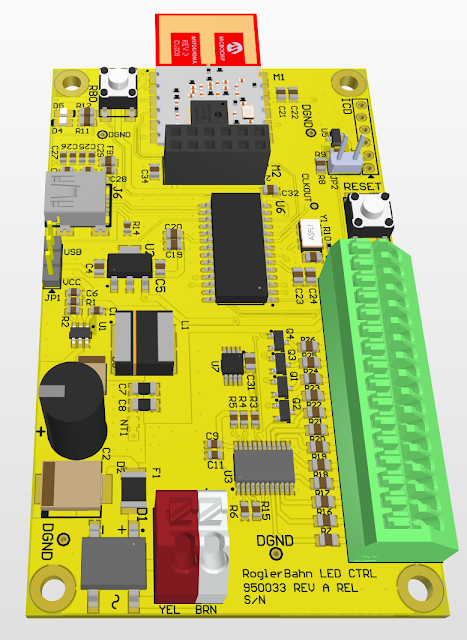
Tuesday, February 1, 2022

Turnout & Signal Control Firmware/PC SW (Part 2)


I am going to modify this series to include the PC software, since the PIC18F firmware and the PC software are intertwined.  In the last post on this subject, I discussed some of the startup issues of getting the firmware working with the Microchip XC8 compiler, since the C18 compiler is no longer available and issues with the PIC18F47J53 itself..  Having worked through those issues, the "bringup time" on the real PCB was reduced.  There were still several "coding issues" that had be resolved.  I had put in quite a few compiler #ifdef directives.  These blocked sections of code for the Explorer 18 Development board and the real PCB.  Obviously I could not test the real PCB sections until the PCB was available.  Mostly it was coding errors of PIC18F pins and registers.

It took a little more than a day to get the PIC18F47J53 working with the EEPROM, the MCP23S18 IO Expanders and the MRF24J40 module.  So how do I test this.  

Initial Testing

The first testing I do is timer testing.  I have debug routines written for all the basic timers. In this processor those are, Timer1, Timer3 and Timer5.  I have predefined periods of 1ms, 10ms and 25ms.  Then I toggle a GPIO pin based on this and measure the output on a scope (Analog Discovery 2 in this case).  This serves multiple purposes.  First it verifies that all of the clock calculations that are defined are correct and that the timer periods are correct.  

    /*******************************************************************/
    /********************** CLOCK DEFINITIONS **************************/
    /* this is where the clock is set for calculations elsewhere       */
    /*******************************************************************/
    #define CLOCK_FREQ 48000000
    /*********************************************************************
    * Overview: These macro returns clock frequency used in Hertz.
    ********************************************************************/
    #define GetSystemClock()                    CLOCK_FREQ
    #define SYS_CLK_FrequencySystemGet()        CLOCK_FREQ
    #define SYS_CLK_FrequencyPeripheralGet()    (SYS_CLK_FrequencySystemGet()/4)
    #define SYS_CLK_FrequencyInstructionGet()   (SYS_CLK_FrequencySystemGet()/4)
    #define FCY                                 (SYS_CLK_FrequencyInstructionGet())
    #define Fosc                                SYS_CLK_FrequencySystemGet()

Next I will toggle all the GPIO pins to make sure there are no PCB manufacturing errors and no soldering errors.  Once this is done, I can move on to functionality testing.  As you can see from the code segment below, I use #ifdef to block out the debug test routines that are located in the board initialization function.  I have found this is much easier than commenting and uncommenting lines of code. The LED toggle is used a visual cue that something is happening and the code has not "crashed".

    /*******************************************************************/
    /********************** Debug Testing ONLY**************************/
    #define EarlyDebugTesting
    #ifdef EarlyDebugTesting
        while (1)
        {
            TimerOutputTesting();
            PICPortCycle();
            SPIBus_WRITE();
            SPIBus_READ();
            GetBrdSerialNumber();
            SaveBrdSerialNumber();
            mLED_G_Toggle();
        }
    #endif
    /*******************************************************************/

At this point in testing, the PC software communicating with the PIC18F firmware is how all remaining testing is done.  I have created several "Testing Functions" in the PIC18F firmeare that are callable from the PC software.  By changing what happens in these functions, allows me to exercise the entire PC software/PIC18F firmware USB HID interface and the device feature under test.

EEPROM Testing

First tests are can I write and read back the board serial number and EUI address.  Once this was good I moved on to a much more complex operation.  This involves storing the configuration data of the PCB.  More on the features of this below.  Once that worked and I could succesfully read back the configuration, the EEPROM testing was done.  The only other thing I could have done is do write-read of all location using 0x55,0xAA and waling bits.  Something you wold do in product manufacturing environment.  But at this point, if the tests I was doing worked, this full access test would have worked also.  

IO Expander (MCP23S18) Testing

Since the EEPROM was working, the SPI bus is working.  That allows me to move on to more complex testing without having to worry about underlying issues.  I chose to write to the GPIO output registers on each of the three devices.  I write the two different bytes to each of the three devices (16 bit devices), then read them back.  Then I did some simple checking that the output pins are moving.  This was a little difficult since these are open drain outputs.  But I turned on the weak pullups on the outputs to accomplish this testing.

Track Control Testing

As I explained in Part 3, there was some concern about not having pullups on these relay controls. But the MCP23S18 pullups worked just fine.  Since the spring clamp connector was not installed yet, I used a DVOM to measure resistance between the track power feed and the track siding power connection.  As I changed the siding power state in the PC software, the DVOM either shows a short or an open.

LED Control Testing

This was similar to the track control testing, except this is controlled by PIC18F GPIO pins that turn ON/OFF an N-Channel FET.  As in the IO Expander testing, when the FET is off, the output is open drain.  Since the spring clamp connector was already installed, I successively placed a 330 ohm resistor between the 5VDC point and the seven LED pins.  Then the LED control pin either measure 5VDC or ground.

Relay Control Testing

This will be done in two parts.  Once all the circuitry is installed, I will get a turnout and connect it to the PCB and then ground to the train transformer.  Since the spring clamp connectors are not installed, I can use an appropriate size wire in the component holes to control the turnout on each of the 40 positions.  Once this is done, I install the spring clamp connectors and run the test again.  The first test is looking for cold solder joints, firmware issues and PCB manufacturing issues.  The second test is looking only for soldering issues.  The connectors are relatively expensive and hard to remove, so the first test hopefully eliminates any failures that would make the PCB unusable.

MiWi Testing

In the previous incarnation of the turnout and signal control board, I had spent a lot of time getting the MiWi to work.  Also I had done a few consulting projects that used this MiWi Mesh Protocol.  In the Explorer 18 Development board version, I used the latest non-library version that would compile under an XC8 compiler, did not want to deal with libraries.  When I turned the development board on and the current train layout, the development board connected to that MiWi network and all was good.  As described in this Blog Post, I use a Zena Device for the master station.  The PC software connects to it over a USB HID interface and then sends/receives messages to/from the multiple turnout & signal control PCBs mounted under the layout.  Most of the testing above is done using this PC interface and sending/receiving MiWi messages across the network.  While this may not be a comprehensive test, bit error rate, messages dropped, etc, it is good enough for what I am trying to do.

In the next part I will describe the PC software in more detail and some of the issues that had to be resolved as well as others that may not be solved yet.


Monday, January 31, 2022

Train Turnout & Signal Control Design (Part 4)


I have discussed the PCB development in these previous posts, Part 1 , Part 2, and Part3. Here you can see the PCB with most of the components installed.  Only components missing now are the spring clamp connectors and the FETs circuit that drives the 40 relay contacts.

When I built the original PCBs, I only really tested the relay interface.  The track and LED control were only partially implemented in the PIC18F firmware.  Now I am getting more done and have actually tested the track and LED control interfaces and they work as expected.  Since all the relays were installed along with the LED control circuits, I have had the opportunity to test these as well.  Found one cold solder joint, but other than that, all was good.

One item I have not brought up is the small daughter card plugged in perpendicular on the left hand side.  This is a substitute for the MRF24J40MA module from Microchip. This is a Digilent Pmod device (similar to Mikroe Click Boards).  I added a connector for this Pmod board when it became quite obvious buying Microchip MRF24J40MA modules at a reasonable price was going to be impossible.  This PmodRF2 is an excellent temporary substitute for the Microchip module.  I was able to purchase them at Digikey, Mouser and Amazon, so I picked up 6 of them just to have them.  I prefer the Microchip Module since it is soldered down. When the PCB is installed underneath the train layout, this daughter card will be perpendicular to the bottom of the layout.  Underneath the layout will become storage and I am afraid that these cards will get bumped into and either destroy them or the entire PCB.  But for now they are better than nothing.


Sunday, January 30, 2022

Train Turnout & Signal Control Design (Part 3)


I have discussed the PCB development in these previous posts, Part 1 and Part 2. Here you can see the PCB with the power section installed and the PCB running from a train transformer.


The parts that I received from WinSource work just fine.  They were about 2X the Digikey price and $50 DHL charge, put I have parts.  This design uses the LMR14030, which has a 40V input maximum and a 3A output @5VDC.  The 5VDC has three uses

  • Power the digital section through the MCP1825ST 3.3VDC LDO
    • PIC18F47J53, MRF24J40MA, MCP23S18, 24LC160
    • The above use just under 75mA
  • Provide miscellaneous power,
    •  the bias control for the switch/signal relays and power the track control relays
    • This section uses < 10mA, on average
  • LED power for the 7 LED channels
    • This is where most of the 5VDC will be consumed.
    • Probably about 60mA per channel or <500mA

This leads to a total power consumption number of less than 600mA.   So the LMR14030 is a little over kill.  The other two designs, the MiWi to BT Bridge and the Train LED Controller, both use the LMR140100.  This DC-DC converter is from the same family as the LMR14030, but has a maximum current output of 1A, a small reduction in PCB real estate and smaller simpler package to install (no power pad).  If an LMR14010 had been used, the total LED power would have been limited to about 850-900mA.  At a max of 20mA per LED attached, this would provide power for about 40 to 50 LEDs.  With 4 to 5 of these installed and the Train LED Controller, that would have been sufficient. 

Not sure how noisy this DC-DC is, but the USB connected without issues.  I then reinstalled the MiWi code and the entire system connected to the MiWi network.  There are some obvious protocol issues that need to be resolved.  I need to get my TEK scope out to look at the noise factor.  The Analog Discovery 2 is nice, but it has limits when looking at power supply noise.

The MCP23S18 IO expanders have open drain outputs.  I turned this into an advantage with the switch/signal relay control.  Instead of 3.3VDC to turn on the controlling FETs, I designed a way for 5VDC to be used to turn the FETs on, driving them further into saturation and providing a little more current to drive the relays.  There are 3 of these MCP23S18 16 bit IO expanders.  Of the 48 ports, 40 are used for switch/signal relay control.  The remaining 8 are used to control 4 track/catenary control relays (Track ON/Track OFF).  These are used to control the track/catenary power to dead end track sidings.  This provides the ability to park engines and not worry about power being applied to them, especially in the non-digital mode of train operation.  

In my haste to get this board done before Chinese New Year holiday, I missed that the control lines to the FETs controlling these track/catenary relays did not have pullup resistors. Oops😒.  Well the MCP23S18 does have weak builtin pullups that are firmware controlled.  I was worried that they might be to weak to turn the FETs on.  Fortunately the FETs require very little current to turn on and the track/catenay control relays work just fine.

Next is to work on the protocol issues and install the 40 FETs/diodes/resistors that control the switch/signal relays. 


Friday, January 28, 2022

Train Turnout & Signal Control Design (Part 2)


I received the PCB the other day.  I had discussed the design ideas for this PCB in Part 1.The request was for yellow solder mask with black silkscreen.  As you can see from the picture above, it is more orange than yellow.  I think there was too much RED left in the solder mask machine when they applied the yellow.  Oh well it is different and the price for a 4 layer was still very good.  Hopefully there wont be any other problems with the PCB.

Here is the digital part working.

All of the digital uses 3.3VDC.  The power section takes 16VAC (train layout voltage) and generates 20VDC+ (straight out of the full wave bridge with some capacitance) for activating the turnout/signal relays and then generates 5VDC (for LEDs and relay bias control) with a small DC-DC converter.  The 3.3VDC is generated from a small LDO.  Look close to the right of the push button and below the jumper and you can see a space wired SOT23 device.  The LDO was supposed to be a SOT223-3 device.  My first choice was a MCP1825ST, but was out in time to next Xmas, so I found what I thought was a pin compatible LDO, it wasn't.   Now I have found one (triple check), but I thought I would wait a few more days to see if anything else needs replacing. 

The jumper selects either the Power Section 5VDC or VUSB.  That way I can power the digital section without the train transformer and still do debugging and programming.  The Analog Discovery 2 from Diligent is helpful when looking at changing outputs.  With the 34" monitor, I can run a remote desktop window for my other laptop which is running the Digilent Waveforms and the PC program that interfaces to the PCB.  The main laptop has the MPLABX and ICD connection. 

Next up is the power section.  The DC-DC converters came in today, we will see if the Asia reseller market has real parts.


Thursday, January 20, 2022

Train LED Controller


I completed my last design for a while.  This is the LED controller for the lights in the buildings, freight yards, etc.   It has 12 LED channels, 8 of them are controlled by an I2C based LED controller and 4 by the PIC.  The 4 PIC channels are connected to PWM channels and the LED controller has individual PWM controllers for each of the 8 channels.  This will allow for some different lighting effects besides just off and on.

This uses the PIC18F27J53 processor and a MRF24J40MA MiWi transceiver.  As I have done with the switch/signal board, I also included a connector for the PMOD version of this.  I have several of those and will have to use them until the MiWi Module becomes available from other than the resellers.

This was done on Sunday, but during the final purchase review I discovered that the LED controller I picked did not do everything I wanted.  I had discovered a LED controller (LP5569) from TI when working on the new Brick Controller design.  It was a 9 channel (triple RGB) sink style controller, but with a current limit of 25mA that was software controlled.  That was OK for a Lego display and might have worked for the train.  But that IC disappeared, with next availability sometime in 2023.  I found a firmware compatible earlier version (LP55231) at a Chinese reseller so I bought the MOQ qty of 20, but at 5x the price.  This new LED controller is a source style, 25mA limit.  After much thought on how this PCB would be used in layout lighting, I decided that 25mA was too much of a restriction and in the end did not like the source style.  I had considered placing a N channel FET in each channel to increase the current limit, but that just seemed like adding a lot of complexity.

So after a day of searching for alternatives that can be purchased, I found one from NXP.  This is an 8 channel sink style controller, each channel can sink 100mA.  The TI controller was in nice compact 24 pin QFN with a big power pad on the bottom.  The NXP is in a 24 TSSOP package, though it has 4 ground pins.  We will see how it handles lots of current.  This NXP does come in a QFN, but it is being discontinued.  I had to give up the RGB feature of the LP5569/LP55231, but I have not found an application for that feature yet.

This design has a DC-DC converter that converts the 16VAC to 5VDC @ 1A+.  The processor and the radio use about 50mA, so the rest is dedicated to lighting power.  It also has 8K or bigger I2C EEPROM for storing the lighting configuration, so on power up a standard lighting arrangement will be executed.  I wanted to use a SPI EEPROM, since the other two boards use those.  But the PIC18F27J53 has 2 MSSP devices, but has only one I2C port and it is fixed (electrical requirements of I2C dont allow for reassignment) and uses the same pins as the fixed SPI port.  So when you use an I2C port on this part, you loose a SPI port.  Since the radio module wants to be on its own SPI port and the LED controller needs an I2C port, the EEPROM became I2C.  Which created its own availability nightmare.  Mostly finding an IC package and industry standard firmware access I might be able to buy in the future.


Wednesday, January 19, 2022

A MiWi to Bluetooth Bridge


To control the train system I used the Zena Wireless Adapter, pictured below from Microchip.  The Zena has a PIC18F27J53 and the MRF24J40 MiWi transceiver.  I actually opened it up and reprogrammed it so it would handle by higher level protocols.  One big downside is even with a USB Bootloader, you still have to open it up.  Also I am constantly misplacing it, since it is just a USB dongle.

AC182015-1 Microchip Technology | Mouser

I also would like to use the Tablet/Phone to control the trains.  This means either a MiWi-Wifi bridge or a MiWi-Bluetooth bridge.  I bought the Microchip developers kit for the Wifi bridge, but I have never figured out to do these micro web servers, etc.  With Bluetooth I have extensive libraries, since I use it for quite a few of my little modules.  So the picture at the top of this post is the answer.  This PCB will be mounted on the edge of the train layout so that I can connect a USB cable when needed.

What is it?

The design is quite simple,  A 2" x 4" 2 layer board that is everything the Zena is plus a BT module and some LED power.  Since you cant buy MRF24J40MA modules until late 2022/early 2023, I decide to go a slightly different route.  I can buy the Mikro Bus CLICK versions (https://www.mikroe.com/mikrobus).  On some level just plugging in a module is appealing,  I did violated the Mikro Bus spec by only connecting the lines I need and in my configuration.  But the configuration seems to be the same for all the MiWi and BT Click modules.  Thus you will be able to use this PCB to build a bridge between any MiWi module (2.4GHz, 900Mhz and 315Mhz) and any BT device that a CLICK module exists for. 

This design has a DC-DC converter that converts the 16VAC to 5VDC @ 1A+, but is good up to 24VAC input.  The processor and the radios use about 50mA, so the rest is dedicated to lighting power.  I added a SPI EEPROM for storing configuration information. Finally there is a 5VDC switch that will be used for 5VDC LED lighting, using the left Red/White connector.  There is about 800mA+ of excess power.

This one is supposed to be white with black silkscreen, the color rendered did not quite do white, it was 255, 255, 255 though.


Thursday, January 13, 2022

Turnout & Signal Control Firmware (Part 1)


In the last post I described one of the changes I did to this design and how I improved  the relay control.  I have been using an old Explorer 18 dev board to rebuild the firmware for the train control using the XC8 compiler instead of the old C18 compiler.  The C18 is not available anymore and occasionally there is need for the higher optimization than what the  free mode provides.  The Explorer 18  allows me to use a plugin module with a PIC8F47J53 instead of the processor soldered to the board.  This is the processor that is use for the train control design.

This design requires PPS for moving features to specific pins.  The second SPI port and few other peripherals are only available through PPS.   Due to traffic on the MiWi network, the MRF24J40MA module prefers it's own SPI port.  The second SPI port is used for the I/O expanders (MCP23S18) and the EEPROM that contains the network and train control configuration.  (The 18F47J53 has no local EEPROM and I dont like using PIC flash unless there is no choice, not enough usable cycles.)  I still had the plugin I built for the Explorer 18 that had the MiWi module on it and an EEPROM.

After re-documenting the plugin correctly, I was able to read and write to the EEPROM in a small debug section at the beginning of the program.  (I am using the Analog Discovery 2 to monitor the SPI bus.  Glad I bought that!)  However when running the whole program, the EEPROM read would eventually fail later on in the program.  I could read basic info at the beginning of the program, but once the MiWi network connected, it would fail to read.  The SPI bus showed the EEPROM CS going active, but no clock.

Debugging this became quite fun, since all the EEPROM reads went through one function, but the breakpoints would eventually cause Windows to disconnect the USB and thus I would loose control of the program.   The code where the MiWi network is accessing the EEPROM is buried in a library, which made it all the more fun.

I had assumed that once PPS was selected, all other functions were overridden.   After two days of debugging, I came to the conclusion that this was obviously not true.

Here is what is on RC1
RC1      standard I/O pin
CCP8     capture/compare I/O
T1OSI    Timer1 osc input
UOE      USB UOE output
RP12     PPS pin

The capture/compare feature was turned off, Timer1 was set to internal instruction clock and UOE is a configuration bit option, so this cant be altered by code.  At various run points, none of this changed.  Then I found this little tidbit in the Timer 1 section

"When Timer1 is enabled, the RC1/CCP8/T1OSI/UOE/RP12 and RC0/T1OSO/T1CKI/RP11 pins become inputs. This means the values of TRISC<1:0> are ignored and the pins are read as ‘0’."

Well this can't be true, because this worked on the original design, so something else is going on.  Then I found this footnote:

"The Timer1 oscillator crystal driver is powered whenever T1OSCEN (T1CON<3>) or T3OSCEN (T3CON<3>) = 1. The circuit is enabled by the logical OR of these two bits. When disabled, the inverter and feedback resistor are disabled to eliminate power drain. The TMR1ON and TMR3ON bits do not have to be enabled to power up the crystal driver."

This is where cut and paste gets you and Microchip Tech Docs staff is guilty as anyone is.  The PIC18F47J53 actually has 8 timers, and Timer3 and Timer5 are identical.  For some reason the MiWi library wanted T1OSCEN set,which turned on the crystal driver.  The note implies that this only applies to T1OSCEN and T3OSCEN, when in reality it is the logical OR of T1 or T3 or T5 OSCEN as shown in the Timer schematic in the data sheet.  And then somehow T5OSCEN also was set. Timer 3/5 section additionally explains that this processor has the capability to switch to the Timer1 OSC as a clock source and this mode can turn the crystal driver on also.  Fortunately this is not used that I can find, but I have put in a forced write for this register.

When ensuring that all these bits are in the proper state, the result is a stable system and the Explorer 18 connecting to the MiWi network in the train room.  Still need to verify that all the data transfers are working, but that is much simpler than finding this.

On to the next task